Before You Go… Save 5%
Get 5% OFF your first custom order and be the first to hear about new product launches, exclusive designs, and special offers for military units.

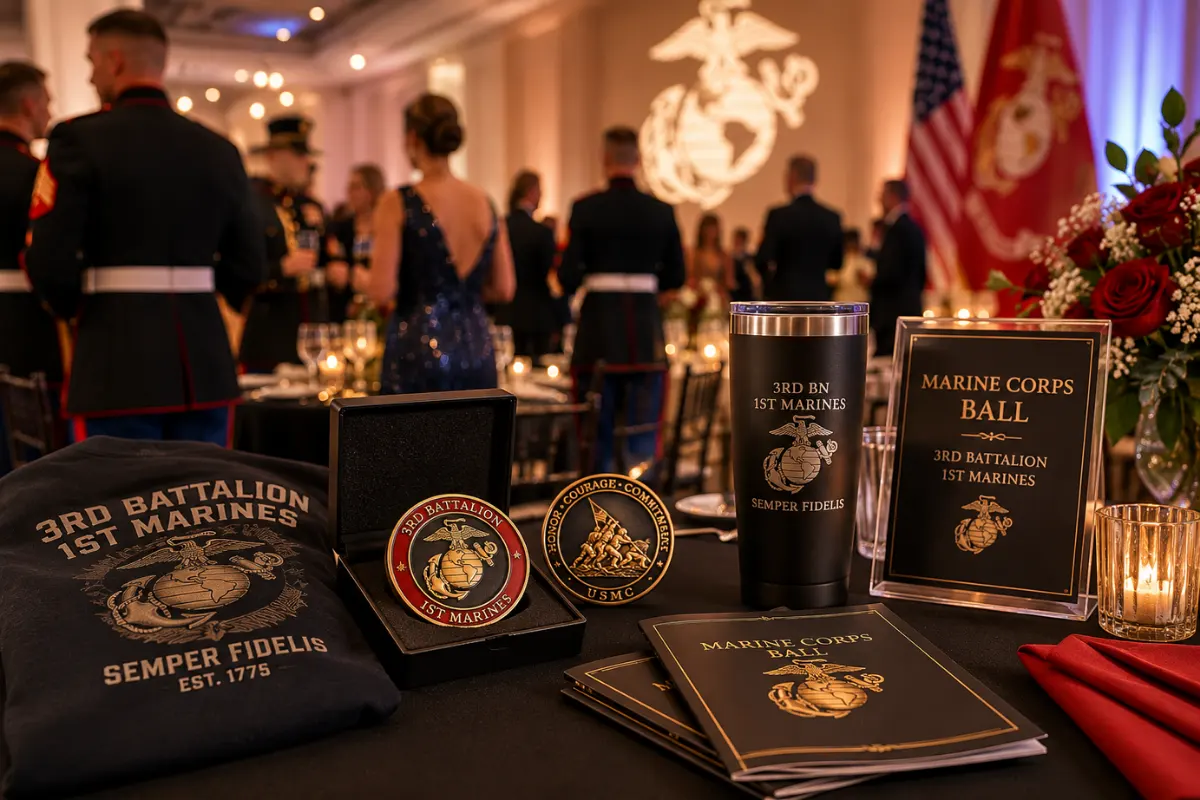
Somebody on the committee is holding a spreadsheet, a rough headcount, and a date that is closer than it looks. Every other part of the ball has a vendor who does this annually and who will chase you: the venue, the caterer, the photographer. Merchandise does not work that way. Nobody calls the committee about the coins until the week they were supposed to arrive.
This is the part of ball planning that fails quietly, and it almost always fails on the calendar rather than on taste. We produce custom merchandise for military ceremonies, and the pattern repeats every autumn. The orders that go wrong are the ones that started three weeks late, not the ones that picked the wrong item.
Before the committee meets again
The Corps was created by a resolution of the Continental Congress on November 10, 1775. General John A. Lejeune, the thirteenth Commandant, issued Marine Corps Order No. 47 on November 1, 1921, directing that a birthday message be read to every command on November 10 that year and on every November 10 after it. That is the date the Corps marks, and it is why the ball exists at all.
It is not necessarily the date your unit holds its ball.
The date that governs your order
Balls get scheduled across late October and through November, worked around unit commitments, deployments, and whichever venue had a Saturday left. A committee that plans backward from November 10 while its own event sits on the 22nd has built a timeline that is wrong in both directions: it looks tighter than it is at the start, and it produces delivery dates that land in the wrong week.
Fix the event date first. Everything in this guide counts backward from your date, not from the birthday. Background on the birthday order is held by Marine Corps University, History Division.
Seven checkpoints, each counted backward from your event. Committees that hit the first two rarely have a problem with the rest, because almost every late order traces back to a headcount and a budget that nobody would commit to in September. This is the sequence a shop that fills these orders every fall will work through with you.
| Item | Who it is for | Typical quantity | When to order |
|---|---|---|---|
| Challenge coins | Every Marine present, sometimes every attendee | Headcount plus 15 percent | 10 to 12 weeks |
| Ball favors and keepsakes | Every attendee, guests included | Full headcount plus 10 percent | 8 to 10 weeks |
| Insulated tumblers | Attendees or unit members | Headcount | 8 to 10 weeks |
| Ceramic mugs | Committee, staff, volunteers | 20 to 60 | 8 weeks |
| Engraved presentation piece | Guest of honor, oldest and youngest Marine | 3 to 6 | 10 to 12 weeks |
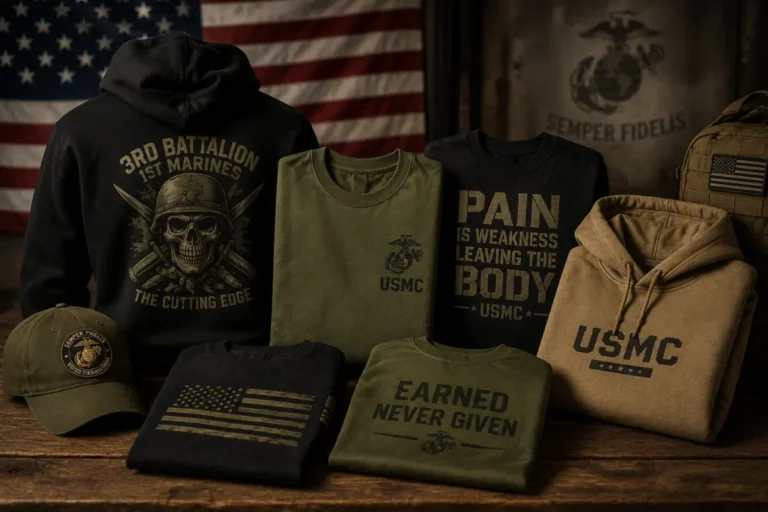
| Unit shirts and hoodies | The informal side of the weekend | Roster based | 10 weeks |
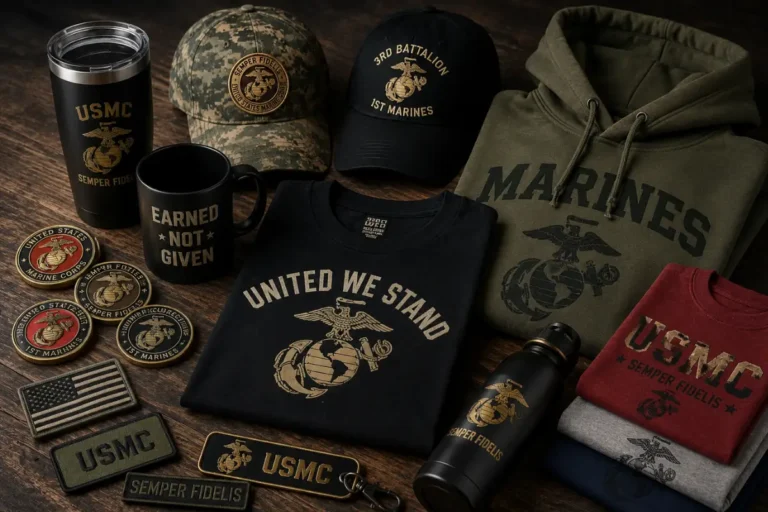
Almost every committee order is some combination of those six lines, and the whole catalog of event gifts for military units exists because of that pattern. What separates a smooth order from a scramble is not which items get chosen. It is understanding that the top half of that table and the bottom half follow completely different rules.
These are priced per head, so the headcount is the whole game. Count attendees, not Marines: guests, spouses, and dates all take a favor, and that is where the undercount happens. Then add a buffer, because people bring someone unexpected and a few items go missing between the box and the table. Choose things that survive the night and get used afterward. Insulated drinkware end up in trucks and offices for years, which is a better outcome than something that gets left on the table with the centerpieces.
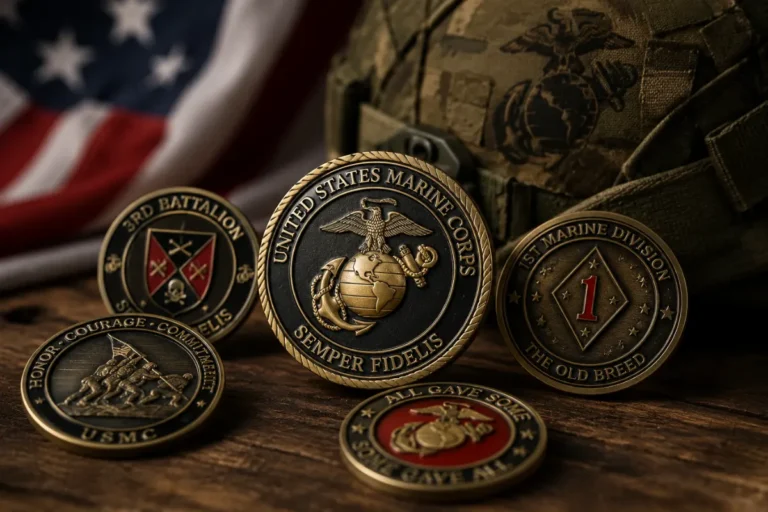
The other half of the order follows the opposite logic. Quantities are tiny, quality is highly visible, personalization is expected, and lead times are the longest of anything you will order. The guest of honor, the oldest and youngest Marine, an outgoing commander, and the committee chair are the usual recipients. A coin handed individually to a guest of honor with a name on it is a different order from three hundred attendee coins, even when it is the same coin, which is worth knowing before you ask for one quote covering both. Our guide to how challenge coins are designed covers the production side, and challenge coins remain the item most committees build the rest of the order around. For the volunteers who did the work and get thanked at the end, ceramic mugs do the job without pretending to be an award.
Most of the people reading this will run another event within a year, and the machinery transfers. What changes is the ratio between volume and presentation, and how much notice you get.
| Occasion | What changes | Typical lead time |
|---|---|---|
| Change of command | Two audiences at once, the unit and the departing commander’s family. The presentation piece carries more weight than the volume | 8 to 10 weeks |
| Retirement | One person and one career. Quality and personalization over quantity, every time | 8 weeks |
| Reunion | Attendees pay their own way, so items are sold rather than issued. Pricing and size ranges matter more | 10 weeks |
| Promotion | Small, fast, and often short notice. Simple items that do not need a long production window | 6 weeks |
| Deployment | Whole roster, and two separate moments. Order the departure and the homecoming together | 10 to 12 weeks |
What the committee finds out too late
Committees usually arrive with one number and no structure for spending it. This split holds up across most unit sizes, and it is more useful than a price list because it survives whatever your actual budget turns out to be.
| Budget line | Share of merchandise spend | Why |
|---|---|---|
| Attendee items | 60 to 70 percent | Unit cost times headcount. The largest line and the one most sensitive to a bad count |
| Presentation items | 15 to 25 percent | Tiny quantity, high visibility. This is the wrong place to economize |
| Buffer for extras and rush | 10 to 15 percent | Something always gets added late. A committee without a buffer cuts an item instead |
| Shipping | Small, never zero | Confirm it is quoted rather than assumed, especially on heavy drinkware |
Shares are structural planning guidance, not prices. Ask for a quote against your headcount and your date.
There are three answers, and they are not equivalent. Unit funds, an attendee ticket price that absorbs the merchandise, or selling merchandise to raise the money in the first place. The third one is far more common than committees admit, and it changes everything downstream: quantities stop being headcount driven, pricing has to carry a margin, and sizes matter because people are choosing rather than receiving. That is a different exercise from the one this guide covers, and it deserves planning as its own project rather than as a line on the ball spreadsheet.
Send your event date, your headcount range, and roughly what the committee has to spend. Our custom order team will tell you what fits and, more usefully, what you still have time to produce. Contact our team even if the committee has not agreed on anything yet. The date is the only thing we need to start.
Twelve weeks out from your own event date, not from November 10. At twelve weeks, you confirm headcount and budget; at ten, you quote; and at eight, the order goes in. Under six weeks, the choice narrows to whatever can be produced quickly.
Two groups. Items for every attendee, typically coins, favors, or drinkware priced per head. And presentation items for a handful of people, usually engraved and personalized, for the guest of honor and the oldest and youngest Marine.
Full attendee count, not the Marine count, plus roughly ten percent. Guests, spouses, and dates all take one, and the gap between attendees and Marines is commonly twenty to thirty percent.
Something engraved, personalized, and clearly a step above the attendee item. Quantity is tiny so the per unit cost matters less than the finish, but personalization adds production time, so order it at the same point as the largest item rather than last.
Rather than a fixed figure, split the merchandise budget structurally: most of it on attendee items, a meaningful share on a few presentation pieces, and a buffer for late additions. Ask for a quote against your headcount for accurate numbers.
No. November 10 is the Corps’ birthday, but units schedule their balls throughout late October and November based on commitments and venue availability. Build your ordering calendar based on your event date.
The process transfers; the ratios do not. Ceremonies prioritize spending on a few presentation pieces over volume, and retirements are almost entirely about one personalized item rather than a run.