Before You Go… Save 5%
Get 5% OFF your first custom order and be the first to hear about new product launches, exclusive designs, and special offers for military units.
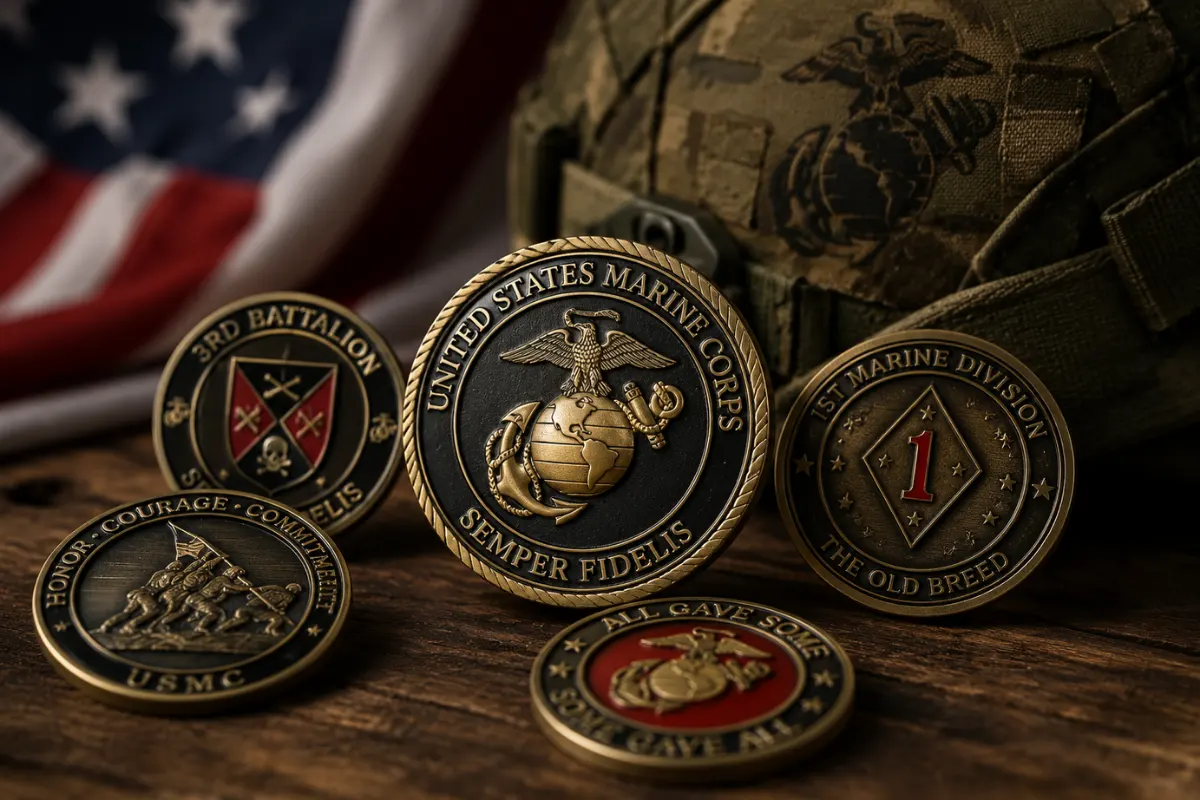
Almost every Marine ends up with at least one. It sits in a desk drawer, on a shelf beside the shadow box, or in a pocket on the kind of night when somebody might call for a coin check. A challenge coin is a small piece of struck metal that carries something a certificate never will: proof that you were there, with that unit, at that time.
This guide covers where the tradition came from, what the historical record actually supports, how a coin check works, and what a unit needs to know before ordering coins of its own. We build custom military merchandise built by Marines, so what follows comes from the production side of the table rather than from a catalog.
The short version
A challenge coin is a unit token, not an award. It carries no rank, appears in no service record, and no board will ever ask about it. Its authority is entirely social, which is exactly why it holds up. Four things separate a coin from a medal, a commemorative token, or a gift shop keepsake:
The honest answer is that nobody can prove where it started. At Buy Tactical Treasures we produce coins for units whose lineage runs back further than the tradition itself, which is part of why the history deserves to be handled carefully rather than copied from the same paragraph everyone else reprints.
Told as history, sourced as legend
A wealthy lieutenant in the First World War has bronze medallions struck for his flying squadron. One pilot is shot down over enemy lines and captured. He escapes, reaches French territory in civilian clothes with nothing to identify him, and is taken for a saboteur. Facing execution, he produces the medallion. A Frenchman recognizes the squadron insignia. The firing squad is called off, and the story ends with a bottle of wine instead.
It is a good story and it may even be true. What it does not have is a verifiable primary source. Treat it as the tradition’s founding legend, told and retold because it captures something real about what the coin means, not as documented fact.
The traceable history is shorter. Unit coins appear in circulation around the Korean War era, and the practice takes clear hold with Army Special Forces units during the 1960s, which is the earliest sustained use most historians will stand behind. From there it spreads across every branch through the 1980s and 1990s, by which point coins presented personally by senior commanders had become a standard form of on the spot recognition.
The coin check itself may have a separate root. One widely repeated account traces it to American units stationed in postwar Germany, where a drinking custom required each member of the group to produce a coin on demand or stand the round. Whether the two traditions merged or grew together, the mechanism is the same: a small object that proves you belong to the group holding it.
Marines came to coins later and more selectively than the Army did. The Corps had never been short of ways to mark belonging, and for years the coin was treated as something borrowed. That changed through the 1990s and accelerated across the deployments that followed, when command coins, deployment sets, and ball committee coins became close to standard practice. Today a Marine can finish twenty years with a drawer full of them, each one attached to a place, a command, and a specific stretch of time.
The coin check is the part outsiders find hardest to believe and Marines find hardest to explain. It works like this:
Most coin orders trace back to a date on a calendar. These are the occasions that drive volume, with the quantities and lead times we see most often:
| Occasion | Typical quantity | Recommended lead time |
|---|---|---|
| Deployment set | 100 to 300 | 10 to 12 weeks before departure |
| Retirement | 50 to 150 | 8 weeks |
| Change of command | 100 to 200 | 8 to 10 weeks |
| Promotion | 25 to 100 | 6 to 8 weeks |
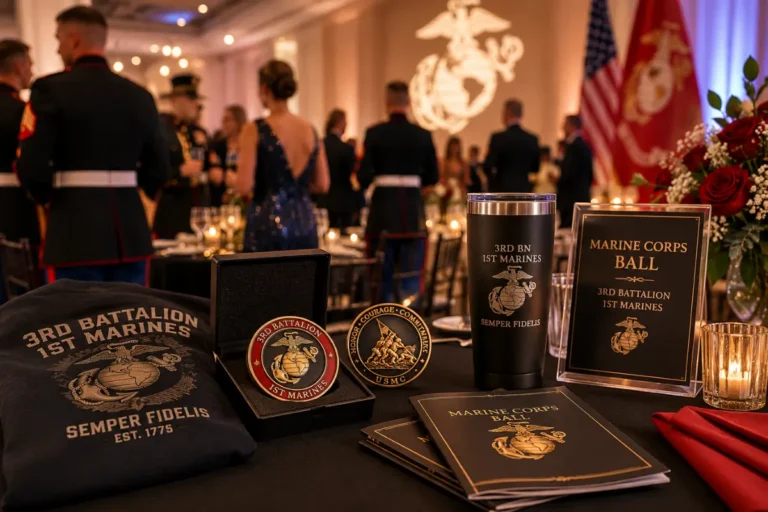
| Marine Corps Ball | 200 to 500 | 12 weeks, which means ordering in summer |
| Reunion | 50 to 200 | 10 weeks |
| Unit fundraiser | 250 to 1,000 | 12 weeks |
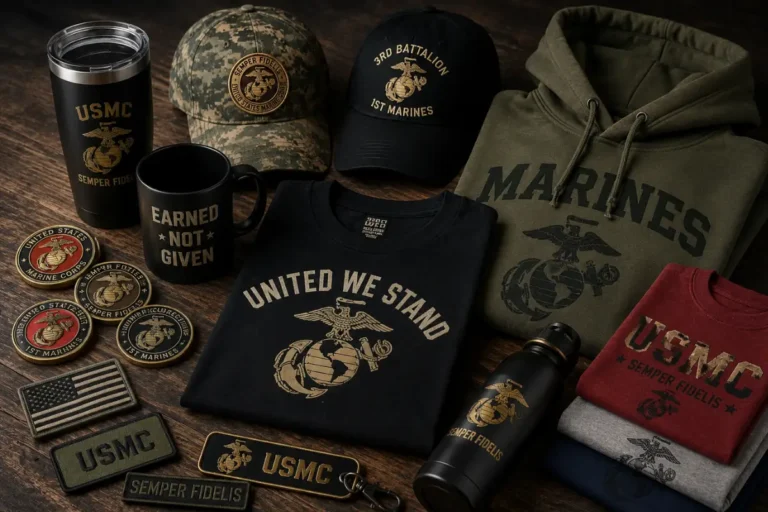
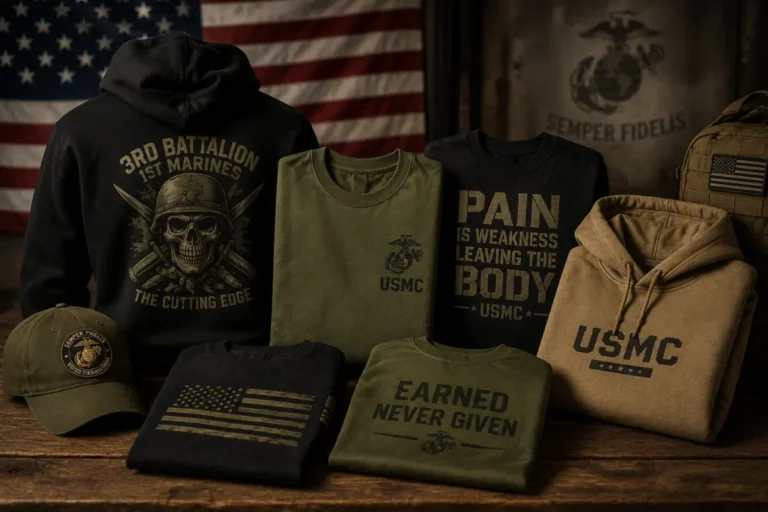
Coins rarely travel alone. A change of command usually comes with military event gifts for the outgoing commander and their family. Deployment sets often ship alongside custom unit hoodies for the same roster. Retirements tend to pair the coin with something the Marine will actually use daily, which is why insulated tumblers outsell plaques by a wide margin. For a committee planning a full order, our guide to Marine Corps Ball and event merchandise breaks down what to buy and when.
Designing custom challenge coins is less complicated than most units expect, and the parts that go wrong are almost never the artistic ones. Six steps, start to finish:
Most unit coins land between 1.5 and 2 inches across. Presentation coins for senior commanders run 2 to 3 inches and heavier, because weight reads as significance in the hand. Plating options usually include antique silver, gold, brass, and copper, along with their polished versions, black nickel, and dual plating that separates two elements of the design. Antique finishes hide handling and read as traditional. Polished finishes read modern and show every fingerprint, which matters more than it sounds for a coin meant to be carried.
Edge treatments such as rope, oblique, cross cut, and spur cost little and change how the coin feels between two fingers, which is most of what a carried coin is for. Three dimensional relief suits aircraft, weapons systems, and sculpted emblems, though it removes the flat surface enamel needs. Sequential numbering on the edge or the back is worth considering for limited runs, plank owner coins, and anything presented individually by name.
A challenge is issued by placing a coin on a surface. Everyone present who has been coined produces theirs within a few seconds. Whoever cannot produce one buys the round, and if everyone produces one, the challenger buys instead. Rules vary by unit, and the local version always wins.
A challenge is issued by placing a coin on a surface. Everyone present who has been coined produces theirs within a few seconds. Whoever cannot produce one buys the round, and if everyone produces one, the challenger buys instead. Rules vary by unit, and the local version always wins.
Yes. Units across all branches, veteran organizations, and first responder agencies routinely order custom coins. The unit supplies and authorizes its own artwork, and any protected insignia should be cleared before the proof is approved.
Price depends on quantity, size, enamel type, and plating. Because the die is a fixed cost spread across the run, the per-coin price falls significantly as volume rises. Request a quote against your actual quantity for an accurate figure.
Industry minimums typically start at 50-100 units. Below that threshold, the setup cost dominates the price, which is why small runs rarely make sense financially.
Roughly five to seven weeks in total: artwork and proof, approval, ten to twenty business days of production, then shipping. For a ball, retirement, or change of command, start eight to ten weeks before the date.
Soft enamel sits recessed below the metal lines, and you can feel the texture. Hard enamel is polished flat to the metal for a smooth, more durable, more premium surface at a higher price. Soft suits feature detailed traditional artwork; hard suits feature clean, modern designs.