Before You Go… Save 5%
Get 5% OFF your first custom order and be the first to hear about new product launches, exclusive designs, and special offers for military units.
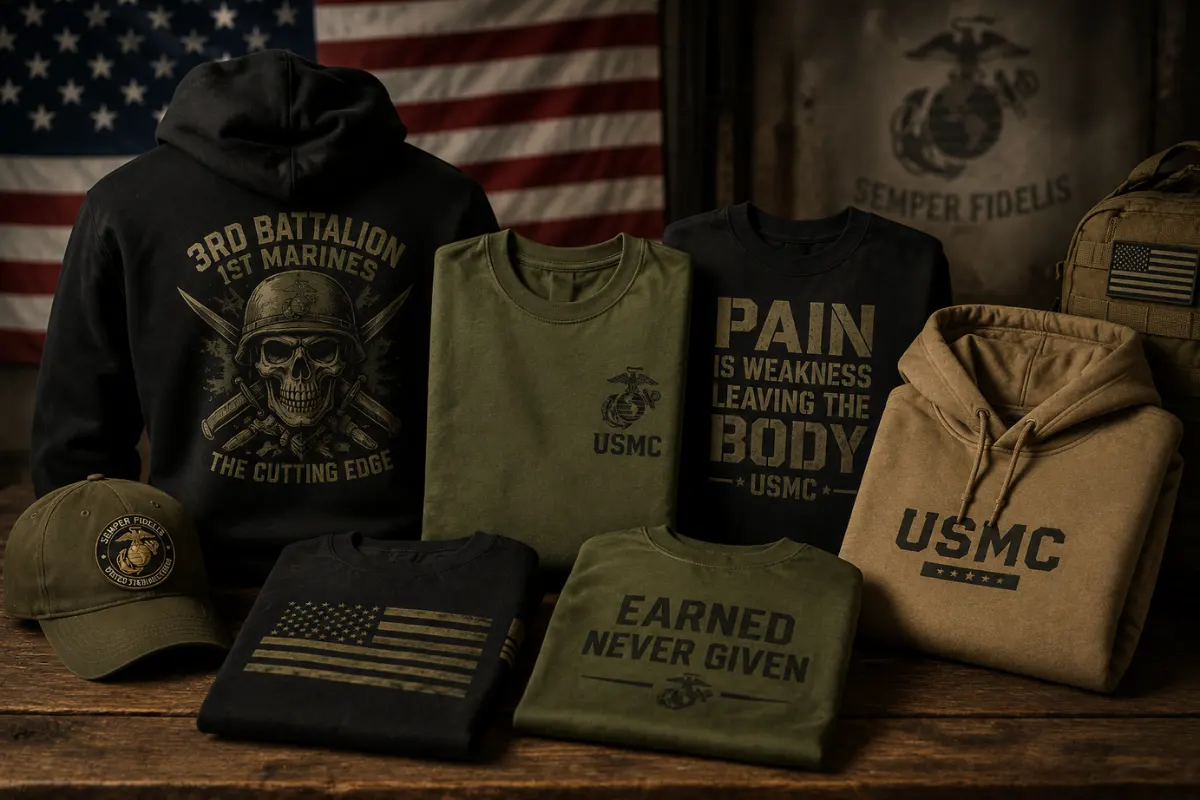
The design is the fun part, which is why most unit apparel orders start there and then hit a wall. Somebody has a good idea for the back of a hoodie, the artwork gets drawn, the committee falls in love with it, and then the quote comes back at three times the budget because the design has six colors and sits on two print locations.
Working in the other direction is faster and cheaper. Garment, then decoration method, then design, then quantity. This guide follows that sequence because it is the sequence a real order forces on you anyway. We produce custom apparel for military units, so what follows is drawn from where orders actually stall.
Three things worth knowing first
The garment sets the ceiling on everything downstream: which decoration methods are available, what the design can look like, and roughly half the final price. Four options cover almost every unit order.
| Garment | What it suits | Typical unit use |
|---|---|---|
| Pullover hoodie, heavyweight | Large back designs, cold weather, keepsake value | Deployment sets, winter unit gear, plank owner runs |
| Zip hoodie | Left chest marks, layering, wear over other clothing | Staff and command teams, everyday unit wear |
| Short sleeve tee | High volume at low cost, widest size range | Reunions, ball weekend shirts, fundraisers |
| Long sleeve tee | Layering, sun cover, cooler training cycles | Field use, formations, training evolutions |
Heavyweight fleece takes embroidery well and holds a large print without the ink cracking, which is why custom military hoodies tend to become the item people still have ten years later. Tees are where volume lives: if the order is going out to a whole battalion or being sold rather than issued, custom military t shirts will nearly always be the right call on cost alone.
This is the decision that moves the quote most, and the one units guess at most often. The four methods are not ranked. They each win somewhere specific.
| Method | What drives cost | Best at | Watch out for |
|---|---|---|---|
| Screen printing | Number of colors and print locations | Medium and high volume, large flat designs | Setup charged per color per location |
| Embroidery | Stitch count, not color count | Hoodies, left chest marks, premium feel | Fine text closes up and turns to a blob |
| Direct to garment | Flat rate per piece | Very low quantity, detailed multicolor art | Weaker on dark heavyweight fleece |
| Heat transfer vinyl | Per name or number applied | Individual personalization | Scales badly across a full roster |
Ink is pushed through a stencil, and each color at each location needs its own screen. That setup is a fixed cost, so the price per garment falls sharply as the quantity climbs. A two color front on 200 shirts is inexpensive. The same two colors on 25 shirts is not, because the same setup is divided among far fewer pieces. When a screen printed quote comes back too high, cut colors before you cut quantity. Dropping a design from five colors to two usually saves more than removing fifty shirts.
Thread instead of ink, priced by stitch count rather than by color, plus a one time fee to digitize the artwork into a stitch file. It reads as more premium, survives washing better than any print, and is the natural choice for a left chest mark on a hoodie or a zip jacket. Its limit is detail. Below a certain letter height the thread fills in the gaps and fine text becomes unreadable, so the fix is to simplify the design for embroidery rather than shrink it and hope.
Direct to garment sprays ink into the fabric itself, which makes it viable at quantities where screen printing setup cannot be justified, and it handles photographic detail no other method can. It performs best on lighter weight cotton and loses contrast on dark heavyweight fleece. Vinyl is a different tool entirely: it exists for individual names and numbers, priced per application, which is exactly why personalizing every piece in a large order gets expensive fast. Most units end up combining methods, printing the shared design and adding names only where they matter. That combination is worth raising early when you look at shirt options.
Every quote you receive depends on these six answers, and every one of them is cheaper to change now than after the artwork exists. This is the checklist a shop run by Marines will walk you through anyway, so arriving with the answers saves a week of email.
The most common way a unit order goes wrong is not production or artwork. It is sizes. Below is a working distribution for a 100 piece order, useful as a starting point when the roster genuinely is not available yet.
| Size | Share of a 100 piece order | Note |
|---|---|---|
| Small | 5 | Order a few. Running out entirely looks careless |
| Medium | 15 | Steady demand across most units |
| Large | 25 | Usually the largest single block |
| Extra large | 25 | Matches or beats large in most unit orders |
| 2XL | 18 | Often carries a price uplift. Budget for it |
| 3XL and above | 12 | Ask the roster. Never assume this is a rounding error |
Treat that as a fallback, not a rule. Unit distributions run larger than general retail data suggests, and they vary widely between a recruiting office and an infantry battalion. A shared sheet that everyone fills in beats any table ever published, including this one. Whatever the count says, add a small buffer in the middle sizes, because people transfer in, garments get ruined, and somebody senior always ends up needing one that was never ordered.
Where orders get held up
| Stage | Typical duration | Notes |
|---|---|---|
| Quote and artwork setup | 2 to 5 days | Faster with usable vector artwork |
| Proof approval | 1 to 5 days | One named approver, not a committee |
| Production | 7 to 15 business days | Varies by method and by quantity |
| Shipping | 3 to 7 days | Domestic ground |
| Total | 4 to 6 weeks | Order 8 weeks out from a fixed event date |
On minimums, the number depends on the decoration method rather than the garment. Screen printing generally needs enough pieces to justify the screens, embroidery starts lower because the setup is a single digitizing fee, and direct to garment works at quantities where the others do not make sense at all. Mixing garments inside one order is usually possible, but it can affect which minimum applies, so raise it when you ask for the quote rather than after.
Timelines and minimum logic shown are typical market conditions for planning purposes, not a quote.
Send the quantity range, the garment, and the date. Our production team will come back with a quote and a proof, and will tell you honestly when a different decoration method would cost you less. Contact our team with what you have, even if the design is still an idea.
Most coin orders trace back to a date on a calendar. These are the occasions that drive volume, with the quantities and lead times we see most often:
| Occasion | Typical quantity | Recommended lead time |
|---|---|---|
| Deployment set | 100 to 300 | 10 to 12 weeks before departure |
| Retirement | 50 to 150 | 8 weeks |
| Change of command | 100 to 200 | 8 to 10 weeks |
| Promotion | 25 to 100 | 6 to 8 weeks |
| Marine Corps Ball | 200 to 500 | 12 weeks, which means ordering in summer |
| Reunion | 50 to 200 | 10 weeks |
| Unit fundraiser | 250 to 1,000 | 12 weeks |
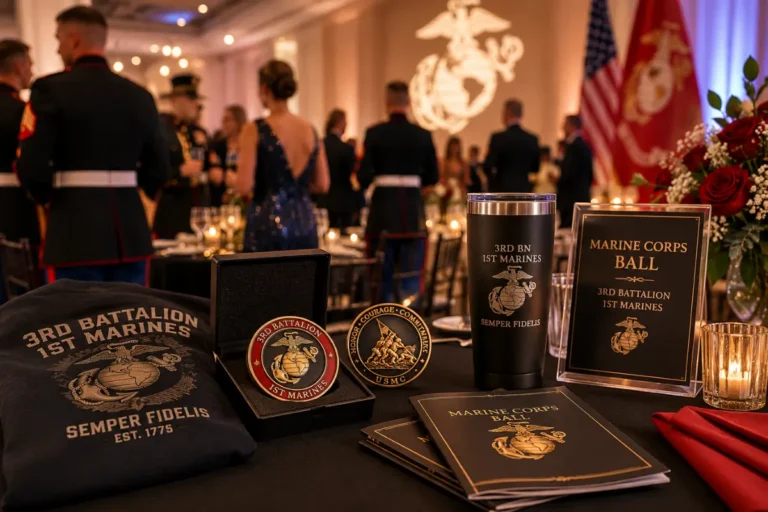
Coins rarely travel alone. A change of command usually comes with military event gifts for the outgoing commander and their family. Deployment sets often ship alongside custom unit hoodies for the same roster. Retirements tend to pair the coin with something the Marine will actually use daily, which is why insulated tumblers outsell plaques by a wide margin. For a committee planning a full order, our guide to Marine Corps Ball and event merchandise breaks down what to buy and when.
The fundraiser line in that table behaves differently from the rest, because the unit is selling rather than issuing. Our guide to military fundraiser merchandise covers the pricing and planning side of that.
Designing custom challenge coins is less complicated than most units expect, and the parts that go wrong are almost never the artistic ones. Six steps, start to finish:
Most unit coins land between 1.5 and 2 inches across. Presentation coins for senior commanders run 2 to 3 inches and heavier, because weight reads as significance in the hand. Plating options usually include antique silver, gold, brass, and copper, along with their polished versions, black nickel, and dual plating that separates two elements of the design. Antique finishes hide handling and read as traditional. Polished finishes read modern and show every fingerprint, which matters more than it sounds for a coin meant to be carried.
Edge treatments such as rope, oblique, cross cut, and spur cost little and change how the coin feels between two fingers, which is most of what a carried coin is for. Three dimensional relief suits aircraft, weapons systems, and sculpted emblems, though it removes the flat surface enamel needs. Sequential numbering on the edge or the back is worth considering for limited runs, plank owner coins, and anything presented individually by name.
Minimums are set by the decoration method rather than by the garment. Screen printing needs enough pieces to justify the screens; embroidery starts lower because setup is a single-digitizing fee; and direct-to-garment works at quantities where neither of the others makes sense.
Embroidery for left chest marks, hoodies, and anything that needs to feel premium. Screen printing for large designs, bright colors, and any order where volume is the point. If the design has fine text, embroidery will struggle with it.
Units supply and authorize their own artwork. Protected emblems and service trademarks should be cleared before the proof is approved, and the licensing office is the authority on what constitutes commercial use.
Roughly four to six weeks in total: quote and setup, proof approval, seven to fifteen business days of production, then shipping. Work backward from the event date and give yourself eight weeks.
As a fallback, weight the run toward large and extra large, keep 2XL and above well represented, and order only a handful of smalls. Collecting real sizes from the roster beats any published distribution, including ours.
Yes, usually with heat transfer vinyl or embroidery applied per piece. Because it is priced per application rather than per run, personalizing an entire roster costs considerably more than printing one shared design.
Usually yes, and mixing hoodies with tees is common. It can change which minimum applies and how the price breaks fall, so mention it when you request the quote rather than after the proof.